The Bere Professional Learning Framework
A framework connecting teacher learning with continuous school improvement — integrating research, policy, leadership, and classroom practice.
Overview
The Bere Professional Learning Framework is a Practice-Informed Conceptual Framework that treats teacher professional development not as an isolated training event, but as a continuous cycle connecting educational research, national policy, instructional leadership, and everyday classroom practice.
At its centre sits student learning — the measure against which every professional learning decision is ultimately judged. Around that centre, four pillars — Research, Policy, Leadership, and Practice — work together rather than in isolation: research shapes what is worth trying, policy (NEP 2020 and NCF-SE 2023) sets the national direction, leadership creates the conditions for teachers to grow, and classroom practice is where all of it is tested against real learners.
Diagram
The four pillars — research, policy, leadership, and practice — converge on student learning.
Purpose
The framework exists to answer a practical question school leaders ask constantly: what happens after a teacher attends a training programme? Its purpose is to close the gap between professional development as an event and professional learning as a culture — giving schools a coherent way to plan, sequence, and evaluate the growth of their teaching staff.
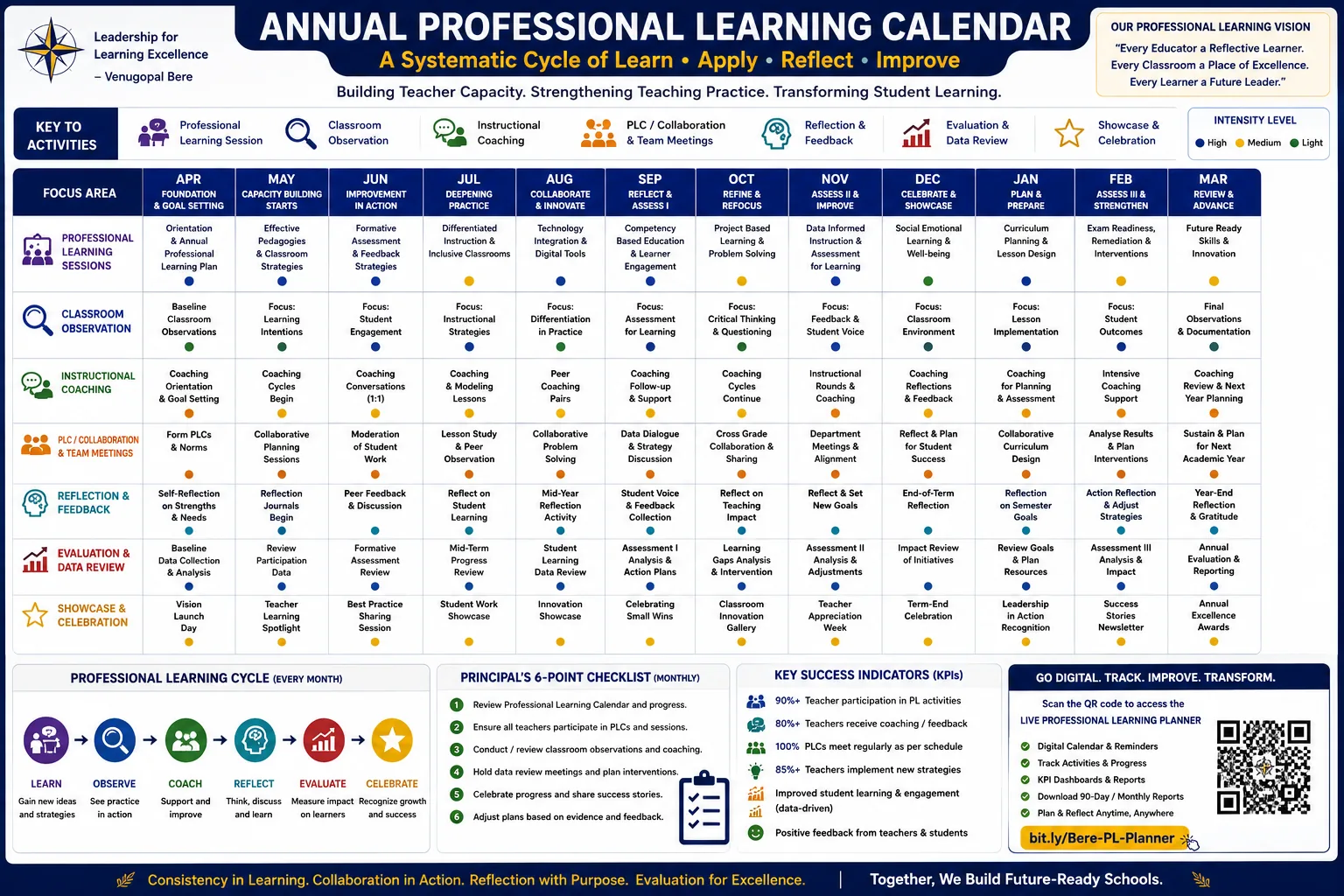
It is deliberately conceptual rather than prescriptive: schools apply it using their own context, calendar, and constraints, guided by the supporting tools (the School Readiness Self-Assessment, the Bere Policy-to-Practice Bridge, the Bere Reflective Practice Cycle, and the Bere 90-Day School Improvement Action Planner) described below.
Application
Schools typically apply the framework in five overlapping stages:
- 1Assess
Begin with a School Readiness Self-Assessment across vision, teacher learning, teaching quality, assessment, and school culture to identify the current starting point.
- 2Align
Connect the school's professional learning priorities to NEP 2020 and NCF-SE 2023 using the Bere Policy-to-Practice Bridge, so PD choices are grounded in the national vision, not just local habit.
- 3Build
Design a structured cycle of observation, coaching conversations (using tools like The Leader's Toolkit), and Professional Learning Communities that give teachers regular, low-stakes opportunities to learn together.
- 4Reflect
Use the Bere Reflective Practice Cycle — teach, observe, reflect, receive feedback, collaborate, refine, teach again — so learning compounds rather than resetting after every workshop.
- 5Sustain
Track progress with the Professional Learning Dashboard and the Bere 90-Day School Improvement Action Planner, turning good intentions into a measurable, time-bound plan.
Research Foundations
- Ministry of Education, Government of India. (2020). National Education Policy 2020.
- NCERT. (2023). National Curriculum Framework for School Education (NCF-SE).
- Knight, J. (2007). Instructional Coaching: A Partnership Approach to Improving Instruction. Corwin Press.
- DuFour, R., & Eaker, R. (1998). Professional Learning Communities at Work: Best Practices for Enhancing Student Achievement. Solution Tree.
- Hattie, J. (2009). Visible Learning: A Synthesis of Over 800 Meta-Analyses Relating to Achievement. Routledge.
How to Cite
Bere, V. (2026). The Bere Professional Learning Framework. The Venugopal Bere Educational Review. https://thereviewer.co.in/frameworks/professional-learning-framework